
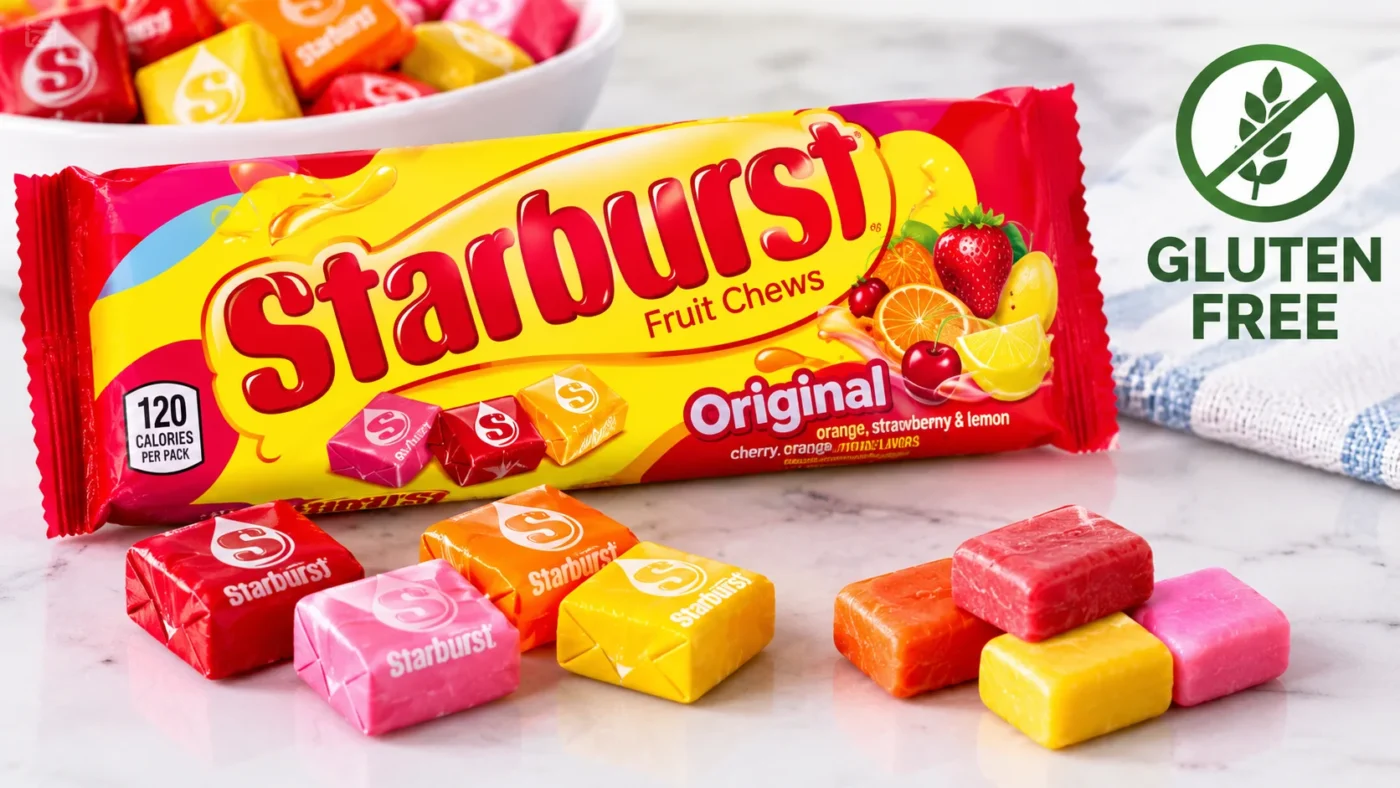
If you are asking, “Are Starburst gluten free?” the U.S. ingredient list offers reassuring news. Original fruit chews contain no listed wheat, barley, or rye ingredients. Still, people with celiac disease should understand several labeling details before eating them.
Quick answer: U.S. Original fruit chews currently list no obvious gluten-containing ingredients. The formula includes corn syrup, sugar, gelatin, dextrin, and modified cornstarch. However, shoppers should check their package because recipes can change, different products may use different formulas, and a gluten-free certification offers extra assurance.
| Question | Quick answer |
|---|---|
| Does the U.S. Original Fruit Chews list wheat? | No wheat appears in the current official ingredient list. |
| Are barley or rye listed? | No. |
| Is the product certified gluten-free? | The official product page does not display a gluten-free certification. |
| Should people with celiac disease check the package? | Yes, especially before eating a new variety or imported product. |
| Does the formula contain gelatin? | Yes, so standard Original Chews are not suitable for strict vegans. |
| What flavors come in original packs? | Strawberry, cherry, orange, and lemon. |
Are Starburst Gluten Free in the United States?
Current U.S. Original fruit chews contain no obvious sources of gluten in their listed ingredients. The official product page lists corn syrup, sugar, oil, acids, dextrin, gelatin, juice, cornstarch, flavors, and colors. Mars also advises customers to use the package for the most accurate ingredient information.
That distinction matters because ingredients and manufacturing information can change over time. A candy that looks safe today may receive a new formula later. Checking each package is therefore more reliable than relying on an old online list.
Foods carrying a voluntary gluten-free claim must contain less than 20 parts per million of gluten, according to the FDA. A product without that wording is not automatically unsafe, but the label provides less formal assurance.
What Ingredients Are in the U.S. Original Chews?
The current official 50-ounce product page provides a detailed ingredient list. It includes sugar, corn syrup, hydrogenated palm kernel oil, citric acid, and tapioca dextrin. It also contains gelatin, apple juice concentrate, modified corn starch, flavors, and food colors.
None of those listed ingredients are wheat, barley, or rye. Tapioca comes from cassava rather than a gluten-containing grain. Modified corn starch is also based on corn in the wording shown on that package.
Some package sizes use the broader word “dextrin” instead of “tapioca dextrin” online. That difference makes package checking especially useful for sensitive shoppers. The manufacturer specifically says the physical label provides the most accurate ingredient and allergen details.
Why Dextrin Can Cause Confusion
Dextrin often creates uncertainty because it can be produced from different starch sources. Seeing that word does not automatically mean a food contains gluten. The ingredient source and required allergen disclosures matter more than the ingredient name alone.
The current large U.S. packs specifically identify their dextrin as tapioca dextrin. Tapioca is naturally free from wheat, barley, and rye. This makes the ingredient easier to evaluate than an unspecified starch source.
Other package pages still display “dextrin” without naming its source. That does not prove the ingredient contains wheat. Consumers with medical dietary restrictions can contact the manufacturer when a label leaves uncertainty.
Does “Not Certified” Mean the Candy Contains Gluten?
No, certification and ingredient content answer different questions. A product can contain no gluten ingredients without carrying third-party certification. Certification can provide additional testing or manufacturing assurances for cautious consumers.
FDA rules govern products that voluntarily use claims such as “gluten-free” or “without gluten.” Those products must satisfy the agency’s gluten threshold and ingredient requirements. Products without the claim cannot be judged only from that absence.
For someone avoiding gluten by preference, reading the ingredient list may provide enough information. People with celiac disease may want stricter reassurance about manufacturing and cross-contact. Their medical needs can justify choosing products with clearer gluten-free labeling.
What About Cross-Contact?
An ingredient list tells you what manufacturers intentionally add to a product. It does not always describe every manufacturing environment or shared production line. That distinction can matter for people who react to small gluten exposures.
The official original product pages tell consumers to check the package for current allergen information. They do not provide detailed cross-contact statements on the pages reviewed here. Consumers needing that information should rely on current packaging or contact Mars directly.
Avoid assuming that “no wheat listed” and “certified gluten-free” mean the same thing. They provide different levels of information. Your appropriate level of caution depends on your medical needs and dietary goals.
Are All Varieties Automatically Safe?
Do not assume every product carrying the same brand uses an identical recipe. Gummies, jellybeans, seasonal items, and special editions can have different ingredient lists. Manufacturing practices may also differ between product types.
Mars currently sells several formats beyond the familiar individually wrapped chews. That makes checking the exact product more important than remembering a brand-wide rule. Read the ingredients and allergen information on the package you plan to eat.
Regional formulas can differ as well. Imported candy may not match the recipe sold through U.S. retailers. Always check the country-specific package before eating an imported version.
What Should People With Celiac Disease Look For?
People with celiac disease should begin with the ingredient and allergen statements. Look for wheat, barley, rye, malt, or other ingredients that require closer investigation. A clear gluten-free claim can provide additional confidence when available.
You should also make sure the package is intended for the U.S. market. International products may use different ingredients despite sharing the same branding. Imported packages deserve a fresh label check rather than assumptions based on domestic products.
If you remain uncertain about production practices, contact the manufacturer before eating the candy. This is especially sensible when cross-contact would create a medical concern. A dietitian or physician can also help set an appropriate personal risk threshold.
Is This Candy Healthy Because It Has No Gluten Ingredients?
Gluten-free status does not determine whether a food is nutritionally balanced. Candy can fit a gluten-free diet while still providing substantial added sugar, so readers cutting back may like our guide to keto-friendly sweeteners. Those are separate nutrition questions.
A six-piece serving from the current 7.2-ounce Original bag contains 120 calories. It contains 16 grams of total sugar, all listed as added sugar. That equals 32% of the daily value for added sugar.
A single 2.07-ounce package contains 240 calories and 33 grams of added sugar. That serving provides 66% of the daily value for added sugar. Portion size therefore matters even when gluten is your main concern.
A Simple Label-Checking Routine
Use the package in your hand rather than relying only on online articles. Recipes, product sizes, and regional formulas can change. A quick review takes little time and gives you more current information.
Check these points before eating:
- Confirm the package is intended for the U.S. market.
- Read the full ingredient list.
- Review the allergen statement for wheat.
- Look for a voluntary gluten-free claim when stronger assurance matters.
- Check unusual varieties separately from original chews.
- Contact the manufacturer if cross-contact remains unclear.
This habit works for other candy brands too. It prevents an old ingredient list from becoming your only evidence. It also helps separate ingredient safety from certification and manufacturing questions.
Frequently Asked Questions
Are Starbursts gluten-free if they contain dextrin?
Dextrin itself does not automatically mean a candy contains gluten. Current large U.S. Original packs specifically identify tapioca dextrin. Check your package because online ingredient wording varies between sizes.
Do Original Fruit Chews contain wheat?
The current U.S. Original ingredient lists reviewed here do not list wheat. They also do not list barley or rye. Mars still recommends checking the actual package for current information.
Are the chews officially certified gluten-free?
The official original product pages reviewed do not display a third-party gluten-free certification. That is different from finding no obvious gluten ingredients on the list. People needing greater assurance can choose products carrying clearer certification.
Can someone with celiac disease eat them?
The ingredient list does not show obvious gluten sources in current U.S. Original products. Individual risk decisions can depend on cross-contact and medical sensitivity. People with celiac disease should check current labels and contact Mars when needed.
Are imported versions the same as U.S. candy?
You should not assume identical formulas across countries. Manufacturers can change ingredients for different markets and production systems. Read the label on imported products before adding them to a gluten-free diet.
The Bottom Line
For U.S. shoppers, current Original Fruit Chews contain no listed wheat, barley, or rye ingredients. Official ingredient pages support that conclusion today. The package remains the best source for the specific product you are holding.
Certification and cross-contact are separate considerations from the ingredient list. People managing celiac disease may reasonably want stronger manufacturing information. Checking labels each time is the safest practical habit.
If sugar is your bigger concern, our low-sugar smoothies for diabetics guide is a useful next read. Compare labels rather than relying on brand names alone. That approach helps you make choices that match your dietary needs.