
Having basal cell carcinoma untreated for 2 years does not automatically mean the cancer has spread throughout your body. BCC usually grows slowly and rarely spreads to distant organs. Still, delaying treatment gives the tumor more time to damage nearby skin and deeper structures.
Direct answer: After two years without treatment, BCC may be larger, deeper, ulcerated, or harder to remove. Distant spread remains rare, but local destruction can become serious. A lesion near the eye, nose, ear, or mouth can threaten nearby structures, so prompt evaluation by a dermatologist matters.
| Key question | What you should know |
|---|---|
| Does two years untreated mean the cancer has spread? | Usually not. Distant spread is rare, but local growth can continue. |
| Can it damage deeper tissue? | Yes. Advanced tumors can reach cartilage, muscle, nerves, or bone. |
| Can treatment still work? | Often, yes. The approach depends on size, depth, location, and subtype. |
| Is Mohs surgery always required? | No. Treatment is chosen according to the individual tumor and patient. |
| Should you keep waiting if the spot seems unchanged? | No. A suspected or confirmed BCC deserves medical evaluation. |
| Who should evaluate it? | A board-certified dermatologist or appropriate skin-cancer specialist. |
Key Takeaways
- BCC is the most common type of skin cancer in the United States.
- Most tumors grow locally rather than spreading to distant organs.
- Untreated tumors can become wider, deeper, and more destructive.
- Lesions around the eyes, nose, ears, and mouth deserve particular attention.
- A long delay can mean removing more tissue during treatment.
- A dermatologist may recommend a biopsy before choosing treatment.
- Treatment options include excision, Mohs surgery, and selected nonsurgical treatments.
- Bleeding, pain, ulceration, or rapid change should prompt medical attention.
What Happens With Basal Cell Carcinoma Untreated for 2 Years?

There is no single timeline showing exactly what every tumor does during two untreated years. Some lesions remain relatively small, while others become noticeably larger or deeper. Growth depends on tumor subtype, location, immune health, and other individual factors.
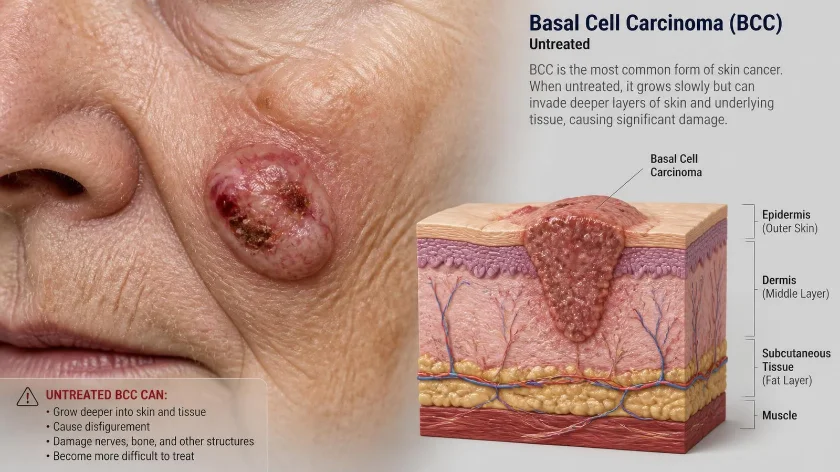
Basal Cell Carcinoma Untreated for 2 Years tends to invade the tissue around its original location rather than quickly spreading elsewhere. Over time, an untreated tumor can extend beneath what you can see on the skin. The American Academy of Dermatology warns that advanced growth can involve cartilage, nerves, muscle, or bone.
This local growth explains why waiting may make treatment more complicated. A small early lesion may require relatively limited removal. A larger or deeper lesion can require wider surgery and sometimes reconstruction.
Why “Slow Growing” Does Not Mean Harmless
The phrase “slow growing” can create false reassurance. Slow growth still adds up when a cancer remains untreated for months or years. BCC does not normally disappear because someone waits longer.
The main danger is progressive local destruction. The tumor may enlarge across the skin or extend deeper beneath its visible border. It can also ulcerate, crust, bleed, or develop a sore that repeatedly opens.
American Cancer Society guidance notes that untreated tumors can invade nearby tissues and underlying bone. Distant spread remains uncommon compared with many other cancers. That difference does not make prolonged local growth safe.
What an Untreated BCC May Look or Feel Like
The appearance can change as the lesion develops. Some tumors begin as shiny or pearly bumps, while others resemble scaly patches or scars. A sore that repeatedly heals and reopens can also be concerning.
Changes that deserve medical evaluation include the following.
- A spot that keeps bleeding or crusting.
- An open sore that does not heal.
- A shiny, pearly, pink, or skin-colored bump.
- A scaly patch that persists.
- Increasing tenderness or pain.
- A lesion that gradually becomes wider.
- A growth developing a central ulcer.
- Changes around an old scar.
These signs are not specific enough to diagnose cancer yourself. Other skin conditions can cause sores, scaling, crusting, or discoloration. A dermatologist can examine the area and perform a biopsy when needed.
For example, facial sores can have several causes besides cancer. HealthySpire also explains how a cold sore inside the nose may behave. A persistent or unfamiliar lesion should not be diagnosed from photographs alone.
Can Basal Cell Carcinoma Spread After Two Years?
Metastasis is possible, but it is uncommon. StatPearls from the National Library of Medicine reports that fewer than one percent of these tumors spread beyond their original location. Local invasion is therefore the more common concern during delayed treatment.
The exact risk cannot be predicted from the number of untreated months alone. Size, depth, location, tumor subtype, recurrence, and immune status can affect risk. A dermatologist needs the clinical examination and pathology findings to assess those factors.
A long-standing lesion should therefore be evaluated even when you feel otherwise healthy. Lack of pain does not prove that a tumor is superficial. Visible size also may not show the complete extent beneath the skin.
Location Can Make a Major Difference
A small tumor in one location may create different problems from a similar tumor elsewhere. Lesions around the eyes, nose, ears, lips, and central face can sit near important structures. Tissue preservation can become especially important in these areas.
Deeper growth near the nose or ear can eventually involve cartilage. Growth near an eye may complicate treatment if surrounding structures become involved. Tumors elsewhere can also become destructive when they have enough time to expand.
This is one reason dermatologists consider location when choosing treatment. They also consider tumor borders, size, subtype, previous treatment, and overall health. Those details matter more than the two-year duration by itself.
What Should You Do After a Two-Year Delay?
Arrange an examination with a board-certified dermatologist rather than continuing to observe the area yourself. Bring any previous biopsy reports or photographs showing earlier changes. Tell the clinician when you first noticed the lesion and how it has changed.
If the diagnosis has never been confirmed, the dermatologist may perform a biopsy. A laboratory then examines the tissue to identify the condition and tumor type. Those results help determine which treatment offers an appropriate balance of removal and tissue preservation.
Do not try to burn, cut, freeze, or chemically remove a suspicious lesion at home. Doing so can cause injury and delay accurate diagnosis. Skin that is damaged for another reason also needs proper healing, as HealthySpire explains in its guide to skin healing after a tattoo.
How Is a Long-Standing BCC Treated?
Surgery remains a major treatment option for many tumors. Standard surgical excision removes the cancer plus an appropriate margin of surrounding tissue. The removed tissue is examined for cancer cells at the edges.
Mohs surgery may be considered for certain higher-risk tumors. The surgeon removes tissue in stages and examines the margins during the procedure. This approach can help preserve healthy tissue in anatomically sensitive locations.
Other options may be suitable for selected cases. These can include curettage and electrodesiccation, topical medicines, radiation, or other local treatments. Nonsurgical approaches generally have narrower indications than surgery.
Advanced disease may require a multidisciplinary treatment plan. Medicines targeting the Hedgehog signaling pathway can treat certain locally advanced or metastatic cases. Such therapy is generally reserved for situations where standard local treatments are unsuitable.
Will Delayed Treatment Cause a Bigger Scar?
A longer delay can increase the amount of tissue that eventually needs treatment. Larger or deeper tumors may require removing more tissue than smaller early lesions. That can increase the complexity of wound closure or reconstruction.
The final scar still depends on many variables. Location, tumor size, surgical method, skin characteristics, and reconstruction technique all matter. A two-year delay does not allow anyone to predict scar size without examining the lesion.
Early assessment gives the treatment team more information and more time to plan. It also reduces the chance of additional growth during continued observation. For general information about the skin barrier, HealthySpire’s explainer on whether men have a pH balance describes how healthy skin conditions vary across body sites.
When Should You Seek Care More Urgently?
Most suspected BCCs do not require an emergency department visit. They should still receive timely medical assessment. Certain changes can justify faster contact with a healthcare professional.
Seek prompt care if a lesion shows any of these signs.
- Starts bleeding repeatedly without obvious injury.
- Becomes increasingly painful.
- Develops a large open ulcer.
- Changes quickly in size or appearance.
- Produces drainage or signs of infection.
- Sits near the eye and affects vision.
- Causes numbness, weakness, or unusual nerve symptoms.
- Appears to extend into nearby structures.
A lesion near the eye deserves particular care if vision changes occur. Severe bleeding that will not stop also requires urgent medical attention. Call 911 in the United States for a life-threatening emergency.
What Is the Outlook After Delayed Treatment?
The outlook for most people remains favorable when BCC can be adequately treated. The American Academy of Dermatology describes the prognosis as excellent when the cancer is properly treated. Problems become more complicated when the tumor has grown deeply into nearby structures.
Treatment does not end the need for skin monitoring. People who have had one skin cancer face an increased chance of developing another. Follow-up schedules depend on the tumor and individual risk factors.
Sun protection also remains important after treatment. Use broad-spectrum sunscreen, protective clothing, shade, and other sensible ultraviolet protection. Regular self-checks can help you notice new or changing areas between professional examinations.
The Bottom Line
Waiting two years does not automatically mean a skin cancer has become metastatic or untreatable. The larger concern is continuing local growth that can destroy healthy tissue. Getting evaluated now is more useful than trying to estimate what happened during the delay.
If you have a confirmed diagnosis or a suspicious nonhealing lesion, schedule a dermatology appointment. Bring previous pathology results and photographs if they are available. Proper examination can show what treatment, if any, is needed next.
Frequently Asked Questions
Is basal cell carcinoma untreated for 2 years still treatable?
Yes, many tumors remain treatable after a two-year delay. Treatment may become more extensive if the cancer has grown larger or deeper. A dermatologist must examine the lesion before predicting the likely treatment.
Can BCC kill you if you leave it untreated?
Death from this cancer is rare because distant spread is uncommon. Serious local destruction can still occur when a tumor grows unchecked. Advanced disease therefore deserves specialist medical treatment rather than continued observation.
Does an untreated tumor always grow during those two years?
Not every tumor grows at the same visible rate. Subtype, location, immune health, and other factors can change its behavior. You cannot safely judge tumor depth by watching surface size alone.
Can BCC disappear without treatment?
A confirmed cancer should not be expected to disappear permanently without appropriate care. A crust may fall off while abnormal cells remain underneath. Repeated healing and reopening can itself be a warning sign.
Will I definitely need Mohs surgery?
No. Mohs is one treatment option rather than an automatic requirement after a delay. Your dermatologist will consider location, size, pathology, recurrence risk, and other clinical details.
What if the spot has not changed much in two years?
Visible stability does not confirm that a lesion is harmless. Suspicious or biopsy-proven cancer still deserves professional assessment. Ask a dermatologist whether treatment or medically supervised observation is appropriate for your circumstances.