
An MRI can provide detailed images of the brain, spine, joints, organs, blood vessels, and other structures, but the bill can be surprisingly difficult to predict. The price depends on the body part being scanned, whether contrast is required, where the scan is performed, and how your insurance plan handles diagnostic imaging. Two people receiving similar MRIs in the same city can therefore face very different charges.
Symptoms such as persistent head heaviness or pressure are among the complaints that lead a clinician to order one of these scans. For most patients, the most useful question is not simply how much does an MRI cost, but how much they personally will have to pay after discounts or insurance benefits are applied.
Current U.S. pricing data show substantial differences between freestanding imaging centers and hospital outpatient departments, making comparison shopping particularly valuable for a scheduled MRI. Understanding the major cost factors before booking can sometimes reduce the bill by hundreds or even thousands of dollars.
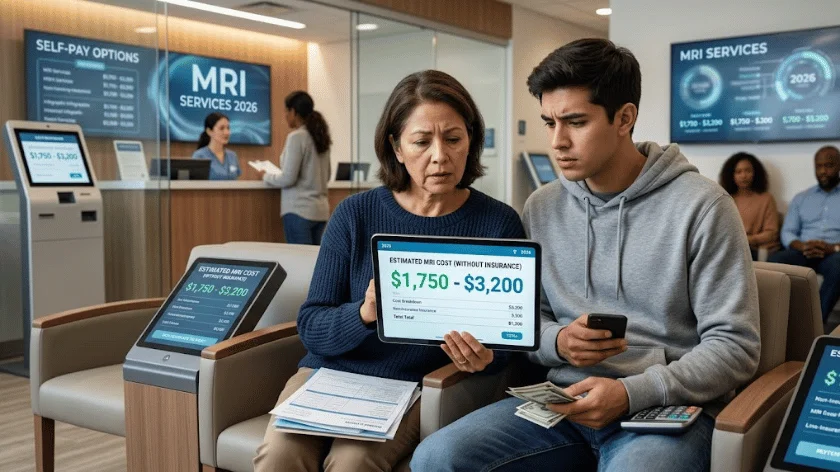
Quick answer: In the United States, a self-pay MRI commonly costs about $400 to $3,500, although some hospital charges can be considerably higher. Freestanding imaging centers often offer lower prices than hospital outpatient departments. With insurance, your cost depends mainly on your deductible, copay or coinsurance, network, and the insurer-negotiated price.
How Much Does an MRI Cost in 2026?
There is no single national MRI price because “MRI” covers many different procedures and billing codes. Current consumer pricing data place many self-pay scans in roughly the $400 to $3,500 range, while some broader published estimates extend much higher for expensive hospital settings or complex studies.
MDsave, for comparison, currently lists estimated national averages of about $900 for an MRI without contrast and roughly $1,334 for an MRI performed both with and without contrast. The figures below are useful planning benchmarks, not guaranteed quotes. They illustrate how the body part and use of contrast can change pricing, while local facility prices can still fall below or above these ranges.
FAIR Health also recommends comparing procedure costs geographically because provider charges and insurer-allowed amounts differ by location.
| MRI type | Approximate national self-pay range | Approximate midpoint/median benchmark |
|---|---|---|
| Brain MRI without contrast | $250–$3,500 | About $650 |
| Brain MRI with and without contrast | $400–$3,500 | About $1,400 |
| Lumbar spine MRI without contrast | $300–$3,500 | About $750 |
| Knee MRI | $350–$3,500 | About $750 |
| Shoulder MRI without contrast | $250–$3,200 | About $650 |
| Abdomen MRI without contrast | $350–$4,000 | About $800 |
These are national reference ranges compiled from healthcare pricing data and should not be treated as a quote for a specific facility. Your ZIP code, exact CPT code, insurance status, and additional professional or facility fees can change the final amount.
How Much Does an MRI Cost Without Insurance?
Without insurance, the amount printed on a hospital’s standard charge list does not necessarily represent what you must pay. Many hospitals and independent imaging centers publish or offer discounted self-pay prices, and the cash price can be dramatically lower than an undiscounted charge. Asking specifically for the self-pay, cash, or prompt-pay rate can therefore produce a more realistic estimate.
Freestanding imaging facilities are often among the least expensive places to obtain a scheduled scan. Current national benchmarks cited by healthcare pricing resources put many single MRI cash prices at approximately $400 to $700 at independent facilities, compared with roughly $1,500 to $3,500 at hospital outpatient departments.
The difference is significant enough that comparing facilities may matter more financially than small differences between scan types. Uninsured and self-pay patients also have a federal protection that can make planning easier. When you schedule qualifying care at least three business days in advance or request an estimate, healthcare providers generally must provide a Good Faith Estimate showing expected charges.
CMS guidance on your rights against surprise medical bills states that when a final bill runs at least $400 above the expected charges shown on that estimate, a federal patient-provider dispute resolution process may be available.
How Much Does an MRI Cost With Insurance?
Having insurance does not automatically mean an MRI will have a small copay. Your plan may require you to satisfy some or all of your deductible before it begins sharing the cost, after which a copayment or coinsurance percentage may apply. HealthCare.gov defines a deductible as the amount you pay for covered healthcare services before your plan begins paying according to its benefits.
Suppose your insurer’s negotiated rate for an MRI is $900 and you have already met your deductible. If your plan requires 20% coinsurance for diagnostic imaging, your simplified share would be $180, and the insurer would pay the remaining covered amount.
If you still had $600 left on your deductible, however, your responsibility could be much higher because the deductible would generally be applied before the remaining coinsurance calculation.
| Example insurance situation | Simplified patient cost on a $900 allowed amount |
|---|---|
| Deductible already met + 20% coinsurance | $180 |
| $600 deductible remaining + 20% coinsurance on remaining $300 | $660 |
| Plan charges a fixed imaging copay. | Depends on plan |
| Out-of-network imaging center | Potentially much higher |
| Out-of-pocket maximum already reached for covered in-network care | The plan may pay 100% of additional covered costs. |
These examples are illustrations, not benefit guarantees, because insurance contracts differ. A plan’s allowed amount, network status, prior-authorization rules, deductible, copay, coinsurance, and out-of-pocket spending to date can all affect the amount due. For the most accurate answer, ask the insurer to estimate your responsibility using the imaging center and exact procedure code on your order.
How Much Does an MRI Cost With Medicare?
Original Medicare generally covers medically necessary MRIs as diagnostic non-laboratory tests under Part B when they are appropriately ordered. After the Part B deductible is met, Medicare says patients generally pay 20% of the Medicare-approved amount for covered diagnostic tests obtained in a doctor’s office or independent diagnostic testing facility. Medicare lists the Part B deductible as $283 for 2026.
Hospital outpatient imaging can involve additional cost sharing. Medicare notes that patients receiving the test in a hospital outpatient setting may also owe a hospital copayment, meaning the same type of imaging can cost more out of pocket than imaging performed at an independent facility. Medicare Advantage plans have their own networks and cost-sharing rules, so members should check the specific plan rather than relying on Original Medicare’s 20% rule.
What Makes an MRI More Expensive?
The biggest price differences usually come from the facility, scan protocol, insurance arrangement, and local market, not a single universal MRI fee. A scan performed at a hospital outpatient department can cost substantially more than one performed at a standalone imaging center, even when both facilities perform the same basic test. Published research has also documented large price variation for MRI and other radiology services within U.S. hospitals.
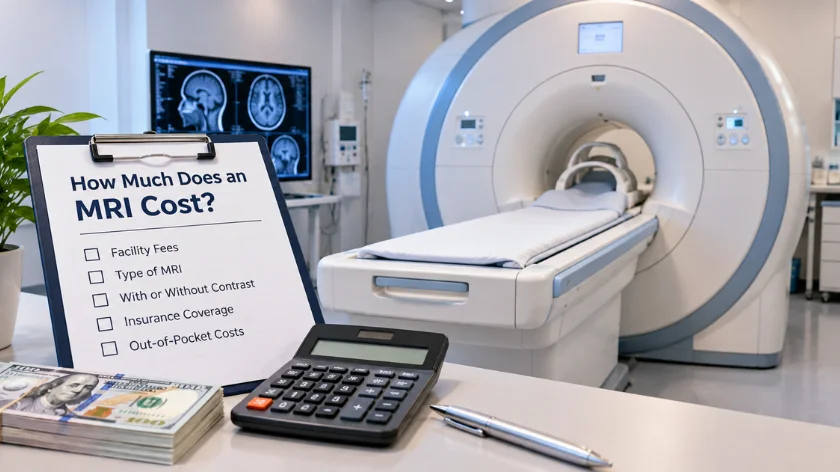
Several factors can change your final MRI bill:
- Facility type: Hospital outpatient departments often charge more than independent imaging centers.
- Body part: Brain, abdomen, cardiac, spine, and joint studies may use different protocols and procedure codes.
- Contrast: Gadolinium-based contrast material may add to the cost when medically required.
- With-and-without-contrast studies: These usually cost more than a scan performed without contrast alone.
- Geographic location: Healthcare prices differ considerably between cities, states, and even nearby facilities.
- Radiologist fees: Ask whether the quoted price includes radiologist interpretation.
- Sedation or anesthesia: Patients who need medication or anesthesia to complete the scan may face additional charges.
- Multiple body regions: Imaging more than one area can result in multiple procedure codes and a higher total bill.
- Network status: An in-network provider normally uses a negotiated insurer rate, while out-of-network care can cost considerably more.
Hospital MRI vs. Imaging Center: Which Costs Less?
A freestanding imaging center is often the first place to check when you can schedule an MRI in advance, and your doctor doesn’t require a specific hospital location. Independent facilities generally have lower overhead than hospital departments, and current consumer cash-price data frequently show materially lower rates outside hospitals.
That does not mean the least expensive facility is automatically appropriate, because the center still needs the equipment, accreditation, protocol, and clinical capability required for your ordered study. Before switching locations, confirm that the new facility accepts the doctor’s order and can perform the exact MRI requested.
Insured patients should also verify in-network status directly with their health plan because a low advertised cash price does not necessarily mean the facility offers the lowest insured cost. Medicare patients obtaining certain advanced diagnostic imaging services outside a hospital should also verify appropriate facility accreditation.
How to Find the Exact Cost of Your MRI Before the Scan
An estimate becomes much more accurate once you know exactly what your doctor ordered. Ask the ordering office for the body region, whether the study is without contrast, with contrast, or with and without contrast, and the CPT code if available. Sharing that information with imaging facilities and your insurance company makes it easier to compare the same service instead of unrelated advertised MRI prices.
A practical price-checking process is
- Get the exact MRI order or CPT code.
- Ask your insurer which nearby facilities are in network.
- Ask your insurer for your estimated out-of-pocket cost.
- Compare at least two or three imaging facilities when clinically appropriate.
- Check hospital price-estimator tools when considering hospital-based imaging.
- Ask each facility for its self-pay price as well as its insurance estimate.
- Confirm whether radiologist interpretation, contrast, and facility fees are included.
- Request a written estimate and keep it with your records.
Federal hospital price-transparency rules can also help with comparison shopping. CMS guidance on hospital price transparency states that U.S. hospitals must make their standard charges available online, including discounted cash prices and payer-specific negotiated charges, and they must offer consumer-friendly information for shoppable services. CMS specifically includes imaging tests among the services consumers can compare before receiving care.
How to Lower the Cost of an MRI
Shopping around is one of the most practical ways to lower the cost because MRI prices vary substantially between facilities. Ask whether a freestanding imaging center is medically appropriate, then compare both the cash rate and your estimated insured rate rather than assuming insurance will always produce the lowest immediate price.
If you choose to pay cash instead of submitting the scan to insurance, first ask your health plan whether that payment will count toward your deductible or out-of-pocket maximum, because plan rules vary. Uninsured patients can also ask about prompt-pay discounts, payment plans, and financial-assistance programs.
Nonprofit hospitals must maintain financial-assistance policies for eligible patients, and other facilities may offer their own discounts or installment arrangements. When requesting assistance, get the terms in writing so you know whether the quoted amount covers the entire imaging service or only one portion of it.
You can also compare local healthcare costs using tools such as FAIR Health Consumer, which provides estimates based on geographic area and distinguishes provider charges from insurer-allowed amounts. FAIR Health’s 2026 updates allow consumers to view a wider range of local cost percentiles instead of relying on a single figure. That can give you a useful benchmark when deciding whether a facility’s quote appears unusually high.
Do Not Delay a Medically Necessary MRI Just Because of the Price
Cost matters, but it should not be the only factor in deciding when to complete an ordered diagnostic test. If a clinician believes imaging is needed urgently, ask about lower-cost locations or financial options instead of postponing the scan without discussing the decision. Emergency symptoms such as sudden weakness, confusion, major vision changes, difficulty speaking, seizures, or severe symptoms after a head injury require prompt medical assessment rather than price shopping.
Not every headache, pressure sensation, backache, or joint problem requires an MRI, either. A healthcare professional determines whether imaging is appropriate after considering symptoms, medical history, physical exam findings, and other testing, which often starts with much cheaper lab work such as a standard MPV blood test.
Readers dealing specifically with persistent head heaviness or pressure can also review Healthyspire’s guide to common causes of head pressure and when to seek care for additional context. Readers whose main complaint is lightheadedness may want to rule out everyday causes of allergy-related dizziness with their clinician before ordering an expensive scan.
The Bottom Line
So, how much does an MRI cost in the United States? Many self-pay patients can expect prices somewhere around $400 to $3,500, while hospital charges can rise much higher, and insured costs depend on the plan’s negotiated rate, deductible, network, and cost-sharing rules. The most reliable ways to learn what your MRI will actually cost before the appointment are to get the exact procedure code, compare qualified facilities, check insurance benefits, and request a written estimate.
Medical disclaimer: This article provides general educational information about healthcare costs in the United States and is not medical or insurance advice. Coverage, prices, and clinical needs vary by individual, health plan, facility, and location. Discuss medical decisions with a qualified healthcare professional and confirm financial details directly with your insurer and imaging provider.
Sources Used for Fact-Checking
- Centers for Medicare & Medicaid Services, Hospital Price Transparency requirements for posted standard charges.
- Centers for Medicare & Medicaid Services, No Surprises: understand your rights against surprise medical bills, including the Good Faith Estimate.
- HealthCare.gov guidance on deductibles, coinsurance, copayments, and out-of-pocket costs.
- Medicare.gov guidance on coverage and cost sharing for diagnostic non-laboratory tests.
- FAIR Health Consumer healthcare cost and geographic comparison resources.
- Published national self-pay pricing databases, including MDsave and hospital price-transparency datasets.
All prices quoted above are published U.S. benchmark figures reviewed in September 2026. They are planning estimates, not quotes, so confirm the current price with your insurer and imaging facility before you schedule a scan.
Frequently Asked Questions
What is the average cost of an MRI in the U.S.?
Published estimates vary because an MRI can refer to many different procedures and settings. A commonly cited national benchmark is around $1,325, while cash prices for individual scans may range from a few hundred dollars at independent imaging facilities to several thousand dollars at hospitals. Your exact price should therefore be based on your location, procedure code, and facility, not a national average alone.
How much does an MRI cost without insurance?
A reasonable planning range for many self-pay MRIs is approximately $400 to $3,500, although individual prices can be lower or substantially higher. Independent imaging facilities commonly sit toward the lower end of the market compared with hospital outpatient departments. Ask for a written cash-price quote and a Good Faith Estimate before a scheduled scan whenever possible.
How much does a brain MRI cost?
The price depends heavily on whether contrast is used and where the scan is performed. Current national benchmark data place a brain MRI without contrast around a $650 median in one pricing dataset, while a brain MRI performed with contrast has a substantially higher median benchmark of about $1,400. Local hospital and insurance-negotiated rates can differ considerably from those figures.
How much does a knee MRI cost?
A knee or other lower-extremity MRI can cost several hundred dollars at a lower-cost outpatient facility and several thousand dollars in a higher-priced setting. One current national pricing compilation places the median benchmark for certain knee MRI studies around $750, with a much wider national range. Confirm the exact CPT code and whether contrast is used before comparing quotes.
Does contrast make an MRI more expensive?
Usually, yes, because contrast material changes the procedure and may involve additional supplies and imaging sequences. MDsave currently lists a higher estimated national average for an MRI performed with and without contrast than for an MRI without contrast alone. Use contrast based on the clinical imaging order, not solely on price.
Will insurance pay for an MRI?
Many health plans cover medically necessary diagnostic imaging, but coverage does not necessarily mean the patient pays nothing. Prior authorization, network restrictions, a deductible, copay, or coinsurance may apply depending on the plan. Confirm both authorization and the estimated out-of-pocket cost before the appointment whenever the scan is not an emergency.
Can I ask for the MRI price before I schedule it?
Yes, and doing so can be particularly helpful for planned imaging. Hospitals must publish pricing information for shoppable services, while uninsured or self-pay patients can generally request a Good Faith Estimate from the provider or facility. Ask whether the quoted price includes the technical scan, contrast if needed, radiologist interpretation, and any separate facility charges.