
If your doctor mentions an endoscopy or colonoscopy, the names can make the procedures sound more alike than they actually are. Both use a thin, flexible tube with a camera to look inside the digestive tract, but they examine different areas and require different preparation. Understanding endoscopy vs colonoscopy can make it easier to know why one test may be recommended, what happens during it, and what recovery is usually like.
Direct answer: An upper endoscopy examines the esophagus, stomach, and first part of the small intestine by passing a scope through the mouth. A colonoscopy examines the rectum and colon by passing a scope through the anus. Colonoscopy also requires a bowel-cleansing preparation, while upper endoscopy usually requires fasting instead.
Endoscopy vs Colonoscopy: What Is the Main Difference?
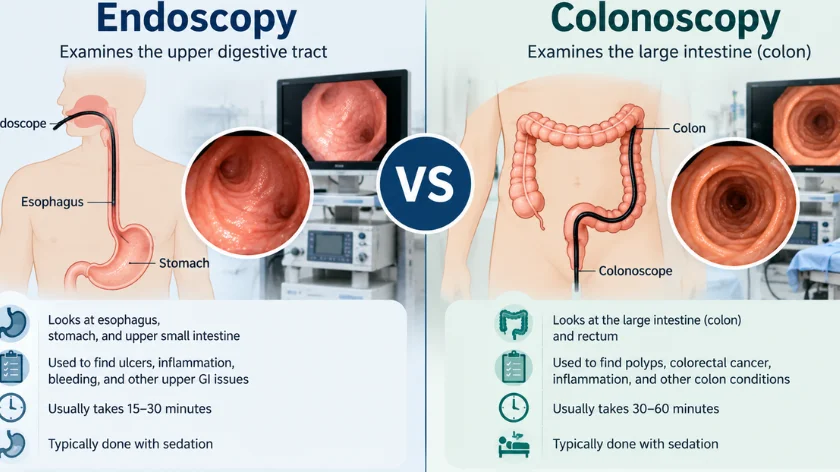
The biggest difference between an upper endoscopy and a colonoscopy is the part of the gastrointestinal tract being examined. In everyday medical conversations, “endoscopy” often refers to upper GI endoscopy, also called an EGD or esophagogastroduodenoscopy, although the word “endoscopy” technically describes a broader family of procedures. A colonoscopy is itself an endoscopic procedure, but it focuses on the lower digestive tract rather than the upper GI tract.
During an upper endoscopy, a doctor guides an endoscope through the mouth and down the esophagus to examine the stomach and duodenum, which is the first part of the small intestine. During a colonoscopy, the colonoscope enters through the anus and travels through the rectum and colon. Both procedures let doctors examine tissue directly and, when appropriate, take biopsies or provide treatment during the same examination.
| Endoscopy vs Colonoscopy Feature | Upper Endoscopy | Colonoscopy |
|---|---|---|
| Main area examined | Esophagus, stomach, duodenum | Rectum and colon |
| Scope enters through | Mouth | Anus |
| Common abbreviation | EGD | Colonoscopy |
| Typical preparation | Fasting | Diet changes plus bowel-cleansing laxatives |
| Sedation | Common, but not always required | Sedation or anesthesia is commonly used. |
| Typical procedure time | About 10–20 minutes | Usually less than 1 hour |
| Biopsy possible? | Yes. | Yes. |
| Can tissue or growths be treated/removed? | Yes, in selected situations | Yes, including removal of many polyps |
| Used for routine colorectal cancer screening? | No | Yes. |
| Usual recovery | Same-day discharge | Same-day discharge |
What Does an Upper Endoscopy Check?
An upper endoscopy gives a doctor a direct view of the lining of your esophagus, stomach, and duodenum. Doctors may recommend it when symptoms suggest a problem in the upper digestive system rather than the colon. Because the doctor can see the lining directly, the test can identify abnormalities that symptoms alone may not explain.
Doctors may use upper endoscopy to investigate persistent upper abdominal pain, ongoing heartburn or reflux symptoms, vomiting, difficulty swallowing, or signs of upper gastrointestinal bleeding. The examination can help identify conditions such as inflammation, ulcers, esophageal narrowing, Barrett’s esophagus, celiac disease, and some cancers. It can also obtain tissue samples, stop certain types of bleeding, remove selected growths, or widen narrowed areas.
Not every episode of nausea, indigestion, or bloating requires an endoscopy. Mild, short-lived digestive discomfort often has a less serious explanation, while symptoms that persist, worsen, interfere with swallowing, cause weight loss, or involve bleeding deserve medical evaluation. HealthySpire’s guide to upset stomach symptoms and common digestive discomfort provides additional context for recognizing everyday symptoms, but you should discuss recurring or concerning problems with a healthcare professional.
What Does a Colonoscopy Check?
A colonoscopy examines the lining of the rectum and colon, which make up most of the large intestine. Doctors use it both to investigate symptoms and to screen people who do not have symptoms for colorectal cancer and precancerous polyps. It can reveal inflamed or irritated tissue, ulcers, polyps, cancer, and abnormalities associated with several colon diseases.
A doctor may recommend colonoscopy for rectal bleeding, persistent diarrhea, a significant change in bowel habits, unexplained abdominal pain, or unexplained weight loss. Doctors also use it to evaluate or monitor conditions such as inflammatory bowel disease and after certain abnormal stool tests or imaging findings. If you notice a new change in bowel activity, it can also help distinguish a persistent symptom from an everyday trigger, such as those discussed in HealthySpire’s guide to how coffee can affect bowel movements.
One major advantage of colonoscopy is that the doctor can remove many polyps during the examination. Most colon polyps are not cancerous, but some can eventually develop into colorectal cancer, so removing them can prevent cancer from developing. The doctor can then send tissue samples and removed polyps to a laboratory for examination.
Endoscopy vs Colonoscopy Preparation
Preparation is one of the most noticeable differences between the two procedures. An upper endoscopy generally requires an empty stomach, while a colonoscopy requires emptying the colon so the doctor can clearly see its lining. Your clinic’s written preparation instructions should always take priority because fasting times, medications, and bowel-prep schedules can vary by patient.
Preparing for an Upper Endoscopy
Before upper endoscopy, you will usually be instructed not to eat or drink for a period before the procedure. NIDDK guidance on upper GI endoscopy notes that patients may be asked to avoid food and liquids for up to eight hours, although individual instructions can differ. You should also tell the medical team about your medicines, supplements, allergies, previous health problems, and any blood-thinning medication you use.
If sedation will be used, you will usually need to arrange for someone to take you home afterward. Do not assume that a general rule about clear liquids applies to your appointment, because the facility may give you more restrictive instructions based on your procedure and health history. HealthySpire’s discussion of fasting before medical procedures explains why medical fasting rules can differ, but your endoscopy center’s directions are the ones you should follow.
Preparing for a Colonoscopy
Colonoscopy preparation is more involved because you must clear stool from the large intestine. You may be asked to limit high-fiber foods several days beforehand, switch to clear liquids for part of the day before the procedure, and take prescribed laxatives that cause repeated bowel movements. Many modern bowel-prep schedules divide the medication into doses taken at different times, often including a dose closer to the procedure.
A successful bowel prep eventually produces watery, light-colored, or clear stool. Poor preparation can hide polyps or other abnormalities and may mean the procedure must be repeated earlier than expected. Contact your medical team if vomiting, severe side effects, or another problem prevents you from finishing the prescribed preparation instead of improvising a different regimen on your own.
What Happens During Each Procedure?
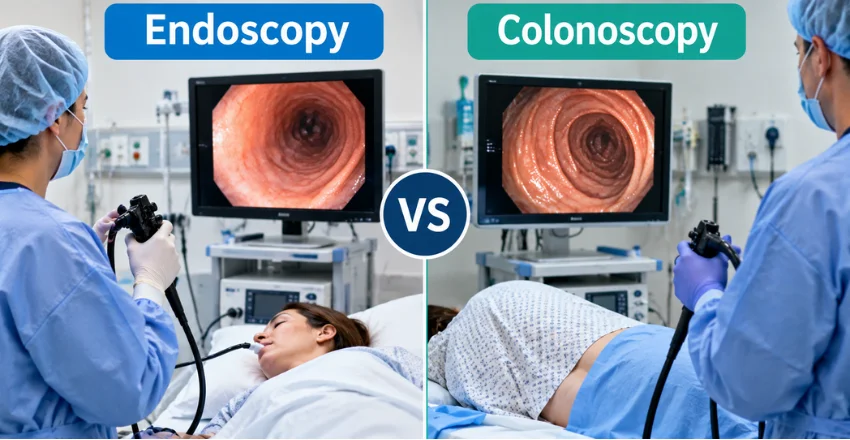
For an upper endoscopy, you generally lie on your side while the healthcare team monitors you. A sedative is commonly given through an IV, and your throat may also be numbed with a spray or liquid medicine to reduce gagging. The doctor then gently passes the flexible endoscope through the mouth, down the esophagus, and into the stomach and duodenum while viewing images on a monitor.
An upper endoscopy commonly takes about 10 to 20 minutes, although treatment or other circumstances can affect the timing. The scope does not block your breathing, and many people sleep through much of the procedure because of the sedative. If the doctor needs a biopsy, they can pass small instruments through the endoscope to collect tissue.
During a colonoscopy, you also usually lie on your side while receiving sedation, anesthesia, or pain medicine through an IV. The doctor guides the colonoscope through the rectum and colon, using the camera to inspect the bowel lining as the scope advances and is withdrawn. The doctor may introduce air or carbon dioxide to expand the colon and improve visibility and can often sample or remove suspicious tissue or polyps during the examination.
A colonoscopy usually takes less than an hour, although procedure time varies according to what the doctor finds and whether treatment is needed. Sedation ranges from moderate sedation to deeper forms depending on the facility and individual patient factors. The medical team monitors you throughout the procedure and then moves you to a recovery area while the medication wears off.
Which Is More Uncomfortable: Endoscopy or Colonoscopy?
Most people worry more about discomfort before these procedures than they do about the actual examination. Sedation is commonly used for both, although some upper endoscopies can be performed without IV sedation, and colonoscopy sedation practices vary. Your experience can therefore depend on the type and depth of sedation, your medical history, the procedure, and whether treatment is needed.
After upper endoscopy, you may have a mild sore throat, nausea, or temporary bloating. After a colonoscopy, gas, abdominal bloating, or mild cramping is common because the colon has been expanded during the examination. These effects generally improve as the air passes and the sedative wears off, although your discharge instructions should explain what is normal for your particular procedure.
For many patients, bowel preparation is the most inconvenient part of colonoscopy, not the procedure itself. The laxative produces frequent diarrhea, so people generally need to remain near a bathroom during the cleansing period. Upper endoscopy avoids that bowel-cleansing process, making its preparation simpler for most patients.
Recovery After Endoscopy and Colonoscopy
After an upper endoscopy with sedation, patients commonly remain at the hospital or outpatient center for about an hour while the medication wears off. You may have mild bloating, nausea, or throat irritation for a short time, and someone else will need to drive you home if sedation was used. Some initial findings may be available immediately, while biopsy results normally take longer. Also worth reading: How Long Does a Tattoo Take to Heal.
After colonoscopy, patients often spend approximately 30 to 60 minutes in recovery. Mild cramping or bloating can occur, and a small amount of rectal bleeding may occur after a biopsy or polyp removal. NIDDK states that most people can expect a full recovery and a return to their normal diet by the following day, although your medical team’s instructions should guide you.
Sedation can affect judgment, coordination, and reaction time even after you feel awake. That is why patients who receive sedation are generally instructed not to drive themselves home. Follow the facility’s restrictions on driving, alcohol, work, important decisions, and medications for the remainder of the day.
Risks of Endoscopy vs Colonoscopy
Both procedures are generally considered safe, but no invasive medical procedure is completely risk-free. Potential complications of upper endoscopy include bleeding, a reaction to the sedative, and perforation, which means a hole in the wall of the upper digestive tract. Serious complications are uncommon, but they may require additional treatment or surgery.
Colonoscopy carries similar potential risks, particularly bleeding, perforation, and reactions to sedation or anesthesia. The NIDDK overview of colonoscopy cites evidence from screening colonoscopies in which perforation occurred in about 3 out of every 10,000 procedures and bleeding in about 15 out of every 10,000. Complications were more likely in some older patients and after polyp removal.
Your individual risk can differ substantially depending on your age, health, medications, and what is done during the procedure. After an upper endoscopy, seek prompt medical attention for worsening chest or abdominal pain, trouble breathing, worsening difficulty swallowing, fever, bloody vomit, or black, tarry stool.
After colonoscopy, urgent warning signs include severe abdominal pain, fever, persistent rectal bleeding, bloody bowel movements that do not improve, or dizziness. Your discharge paperwork may include additional warning signs based on the treatment you received.
When Is Colonoscopy Recommended for Screening in the U.S.?
For U.S. adults at average risk, colorectal cancer screening currently begins at age 45. The American Cancer Society’s 2026 guideline recommends regular screening from age 45 through 75 for people in good health with a life expectancy of more than 10 years, followed by individualized decisions from ages 76 through 85. Colonoscopy is one of several accepted screening options, and an average-risk person with a normal colonoscopy may generally use a 10-year screening interval.
That 10-year interval does not apply to everyone. People with certain polyps, a personal or strong family history of colorectal cancer, inflammatory bowel disease, hereditary cancer syndromes, previous abnormal tests, or other risk factors may need earlier or more frequent examinations. Screening recommendations also apply to people without symptoms, so evaluate symptoms such as rectal bleeding based on the clinical situation rather than waiting until a scheduled screening age.
Upper endoscopy works differently because there is no equivalent universal age-based EGD screening recommendation for the general U.S. population. It is usually performed because of symptoms, a known condition, abnormal findings, or a specific risk that warrants evaluation or surveillance. This is one reason that asking whether everyone needs “an endoscopy at 45” confuses two very different preventive-care situations.
Can You Have an Endoscopy and Colonoscopy at the Same Time?
Yes, a doctor may perform an upper endoscopy and colonoscopy during the same visit when there is a medical reason to examine both the upper and lower digestive tracts. This combined approach is sometimes called bidirectional endoscopy and may be useful when the possible source of symptoms, bleeding, or another abnormal finding is unclear. Whether combining them is appropriate depends on your symptoms, medical history, procedure risks, and the question your doctor is trying to answer.
Having both procedures during one appointment can mean going through sedation and recovery only once. However, you still need to complete the colonoscopy bowel preparation and follow the fasting instructions required for the procedures. Your gastroenterology team will provide one coordinated preparation schedule when both are planned.
Endoscopy vs Colonoscopy: Which One Do You Need?
The right test depends mainly on where your doctor believes the problem is and what condition needs to be ruled out or treated. Symptoms involving swallowing, persistent upper abdominal discomfort, reflux-related concerns, vomiting, or suspected upper GI bleeding may lead to an upper endoscopy, while rectal bleeding, persistent bowel changes, suspected colon disease, or colorectal cancer screening may lead to colonoscopy. Some symptoms and conditions require other tests instead, and occasionally both procedures are appropriate.
Don’t choose a test simply because one seems easier or more comprehensive. A colonoscopy cannot replace an upper endoscopy when the concern involves the esophagus or stomach, and an upper endoscopy cannot properly examine the colon. A healthcare professional can match the procedure to your symptoms, risk factors, previous test results, age, and medical history.
The Bottom Line
When comparing endoscopy vs colonoscopy, location is the easiest distinction to remember: upper endoscopy goes through the mouth to examine the upper digestive tract, while colonoscopy goes through the rectum to examine the colon. Colonoscopy requires bowel cleansing and has an important role in colorectal cancer screening beginning at age 45 for average-risk U.S. adults, whereas upper endoscopy is generally ordered for specific symptoms, conditions, or risk factors.
If either procedure has been recommended, follow the gastroenterology team’s individual preparation instructions and ask what the doctor is looking for, what sedation will be used, and when you should expect results.
Frequently Asked Questions
Is a colonoscopy a type of endoscopy?
Yes. “Endoscopy” is a broad term for procedures that use an endoscope to look inside the body, and colonoscopy is one type of gastrointestinal endoscopy. In everyday conversation, however, doctors and patients often use “endoscopy” to mean upper GI endoscopy specifically, which is why the two names are commonly compared.
Does an endoscopy check the colon?
An upper GI endoscopy does not examine the colon. It examines the esophagus, stomach, and duodenum through a scope passed through the mouth. Examining the rectum and colon requires a colonoscopy or another lower-GI test.
Does a colonoscopy check the stomach?
No. A colonoscope enters through the rectum and examines the colon, not the entire digestive system up to the stomach. A doctor who needs to examine the stomach generally uses an upper endoscopy.
Is colonoscopy prep harder than endoscopy prep?
For most people, colonoscopy preparation requires more work because the colon must be emptied with diet changes and laxatives. Upper endoscopy usually requires fasting but does not normally require a full bowel cleanse. Preparation instructions still vary, so follow the schedule given by the facility performing your test.
Are you awake during an endoscopy or colonoscopy?
You may be sleepy or unaware of much of the procedure when sedation is used, but sedation practices differ. Upper endoscopy can sometimes be performed without sedation, while colonoscopy in the U.S. commonly involves moderate or deep sedation. Your healthcare team can tell you exactly what medication is planned and whether you are likely to be awake.
Can doctors take a biopsy during both tests?
Yes. Instruments can pass through either type of scope, so a doctor can take small tissue samples for laboratory analysis. Most people do not feel the biopsy itself, because the lining of the digestive tract does not sense a small tissue sample the way skin would.
Which procedure detects cancer?
Both can help detect cancer, but they examine different organs. Upper endoscopy can identify suspicious abnormalities in areas such as the esophagus or stomach, while colonoscopy can detect colorectal cancer and precancerous polyps. Colonoscopy additionally has an established role in routine colorectal cancer screening for eligible U.S. adults.