

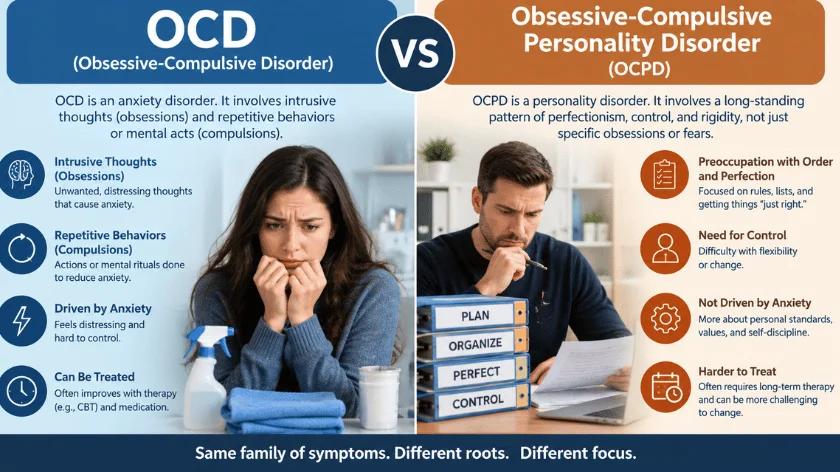
If you are comparing OCD versus obsessive compulsive personality disorder, the names can make two different conditions seem almost interchangeable. They can both involve rigid behavior, but the reasons behind that behavior often differ. Accurate diagnosis matters because treatment plans are not the same.
Obsessive-compulsive disorder and OCPD are different conditions. OCD involves intrusive obsessions, compulsions, or both, often causing distress and disruption. OCPD involves an enduring pattern of perfectionism, control, and rigidity across situations. A clinician distinguishes them by motivation, insight, symptom patterns, and daily impact.
| Feature | OCD | OCPD |
|---|---|---|
| Core pattern | Intrusive obsessions, compulsions, or both | Enduring perfectionism, orderliness, and control |
| How thoughts often feel | Unwanted, intrusive, or distressing | Reasonable, correct, or consistent with personal standards |
| Common focus | Contamination, harm, uncertainty, checking, symmetry, or taboo thoughts | Rules, details, productivity, perfection, delegation, and control |
| Daily impact | Time-consuming rituals, avoidance, or distress | Conflict, inflexibility, missed deadlines, or strained relationships |
| Common treatment approach | ERP-based CBT, medication, or both | Individualized psychotherapy; medication evidence is limited |
| Can both occur together? | Yes. | Yes. |
Comparison basis: NIMH guidance on OCD and NCBI clinical guidance on OCPD.
Key Takeaways
- OCD is defined by obsessions, compulsions, or both, not by neatness alone.
- OCPD is a personality disorder built around enduring perfectionism, order, and control.
- Insight can differ, but it is not a perfect test for either condition.
- Two people can show similar behavior for different psychological reasons.
- A person can meet criteria for both conditions at the same time.
- Treatment differs enough that a professional evaluation can change the care plan.
OCD Versus Obsessive Compulsive Personality Disorder: The Core Difference
The clearest difference is the pattern driving the behavior. OCD usually involves intrusive thoughts and actions aimed at reducing fear, distress, or uncertainty. OCPD centers on rigid standards that often feel sensible or necessary to the person.
Clinicians sometimes describe this contrast as ego-dystonic versus ego-syntonic. Those terms describe whether thoughts feel unwanted or consistent with a person’s self-image. Insight varies widely, so this distinction should guide assessment rather than replace it.
What OCD Can Look Like
OCD can involve unwanted thoughts, images, urges, or doubts that return repeatedly. Compulsions are actions or mental rituals performed to reduce distress or prevent a feared outcome. The relief is often temporary, which can keep the cycle going.
Common themes include contamination, checking, harm, symmetry, morality, religion, relationships, and unwanted sexual thoughts. Compulsions can include washing, checking, counting, repeating phrases, seeking reassurance, or reviewing memories. The National Institute of Mental Health notes that people with OCD often spend at least 1 hour a day on these thoughts or behaviors.
What OCPD Can Look Like
OCPD involves a broad pattern of perfectionism, orderliness, and control across many situations. A person may focus heavily on rules, schedules, details, work, or doing tasks one specific way. These traits can reduce flexibility and create problems at work or in relationships.
Someone may redo a task repeatedly because anything less than perfect feels unacceptable. Another person may refuse to delegate because others will not follow the preferred method. The main issue is a persistent personality pattern, not a cycle of intrusive obsessions and neutralizing compulsions.
The Same Behavior Can Have a Different Driver

Visible behavior alone cannot reliably separate these conditions. Rechecking, cleaning, organizing, or rewriting can appear in several mental health conditions. The reason behind the action often provides more useful information.
A Three-Question Comparison Framework
- What starts the behavior? Is there an intrusive fear, image, doubt, or sense of danger?
- What is the behavior trying to accomplish? Is it reducing distress or meeting a strict personal standard?
- How does the person view the behavior? Does it feel unwanted, necessary, correct, or hard to question?
Consider two people who repeatedly revise a work email. One may fear causing serious harm through a tiny mistake. The other may believe sending anything imperfect shows unacceptable carelessness.
This framework is not a diagnostic test. Anxiety, autism, ADHD, depression, trauma, eating disorders, and other conditions can affect routines or perfectionism. A clinician considers the full pattern, history, and level of impairment. HealthySpire’s Health section covers related wellness topics in plain language.
How Diagnosis Differs in the United States
In the United States, clinicians commonly use DSM-5-TR criteria alongside a detailed clinical assessment. OCD requires obsessions, compulsions, or both. Symptoms must be time-consuming or cause significant distress or impairment.
OCPD diagnosis looks for an enduring pattern beginning in early adulthood and appearing across different settings. The pattern involves orderliness, perfectionism, and control at the expense of flexibility or efficiency. The categorical model requires at least four listed features within that broader pattern. Clinicians also check whether another condition better explains the behavior.
What a Good Assessment Usually Explores
A thorough evaluation usually covers the following areas.
- When the pattern began.
- Whether thoughts feel intrusive or consistent with personal standards.
- What happens when routines are interrupted.
- How much time rituals or perfectionistic tasks consume.
- Effects on work, school, relationships, and daily responsibilities.
- Other mental or physical health conditions that could explain symptoms.
Can Someone Have Both Conditions?
Yes, a person can have both conditions. One diagnosis does not cancel the other, because the disorders use different diagnostic criteria. A clinician may identify separate obsession-compulsion cycles alongside a long-standing perfectionistic personality pattern.
Coexisting symptoms can make treatment planning more complex. A therapist may need to address rituals, avoidance, perfectionism, rigidity, and relationship difficulties together. The treatment plan should reflect the person’s most impairing symptoms and goals.
Treatment Differences Matter
OCD has well-established treatments supported by strong clinical evidence. Exposure and response prevention is a cognitive behavioral therapy designed for obsession-compulsion cycles. Clinicians may also prescribe selective serotonin reuptake inhibitors, depending on symptoms and individual needs.
Treatment for OCPD usually centers on psychotherapy and improving flexibility, insight, relationships, and functioning. There is no single established gold-standard therapy for OCPD, and no medication is FDA-approved specifically for it. Medication may still treat another diagnosed condition when a qualified prescriber considers it appropriate.
| Treatment question | OCD | OCPD |
|---|---|---|
| Is psychotherapy used? | Yes, especially ERP-based CBT. | Yes, with the approach individualized |
| Are medications used? | Often, including certain antidepressants | Sometimes for related symptoms or conditions |
| Main therapy target | Reduce obsessions, compulsions, avoidance, and distress. | Increase flexibility and reduce harmful perfectionism or control. |
| Strength of treatment evidence | Strong evidence supports ERP and established medication approaches | Evidence is more limited, and treatment is individualized. |
Do not choose treatment from a comparison chart alone. ERP should be delivered by a clinician trained to use it safely and appropriately. Medication decisions should always be made with a qualified prescriber.
When to Seek a Professional Evaluation
Consider an evaluation when thoughts, rituals, perfectionism, or control patterns interfere with daily life. Help is also reasonable when relationship tasks take far longer than expected. You do not need certainty about the diagnosis before asking for care.
Stress symptoms can overlap with anxiety, sleep problems, and physical tension. HealthySpire’s guide to a dysregulated nervous system explains why broad stress symptoms need careful interpretation. Its guide to head pressure also explains why recurring physical symptoms should not automatically be blamed on anxiety.
For an appointment, bring a few specific examples instead of trying to label yourself. Note what happened before the behavior, what you feared, and what you did next. Also record how long the pattern has existed and what problems it creates.
Frequently Asked Questions
What is the simplest way to understand OCD versus obsessive-compulsive personality disorder?
OCD is mainly defined by obsessions, compulsions, or both. OCPD is mainly defined by enduring perfectionism, orderliness, and control across situations. The internal reason for a behavior can matter more than how the behavior looks.
Is OCPD a type of OCD?
No. OCPD is classified as a personality disorder, while OCD belongs to obsessive-compulsive and related disorders. Similar names do not mean one condition is a subtype of the other.
Can Someone With OCPD Have Intrusive Thoughts?
Anyone can experience intrusive thoughts occasionally. OCPD itself is not defined by recurrent intrusive obsessions and compulsions. If those symptoms form a separate distressing pattern, a clinician may also assess for OCD.
Which Condition Usually Causes More Distress?
Either condition can cause serious impairment, but the distress may appear differently. OCD often causes direct distress from intrusive thoughts and compulsions. OCPD may cause conflict, inefficiency, relationship strain, or frustration when others resist rigid standards. More from us: Intercostal Muscle Strain.
Are OCD and OCPD Treated the Same Way?
No. ERP-based CBT has a strong evidence base for OCD, while OCPD treatment is usually broader and more individualized. Accurate diagnosis helps a clinician choose the right therapeutic target.
A Useful Next Step
If these patterns sound familiar, consider discussing them with a licensed mental health professional. Bring examples of intrusive thoughts, rituals, rules, perfectionism, and relationship conflicts.